
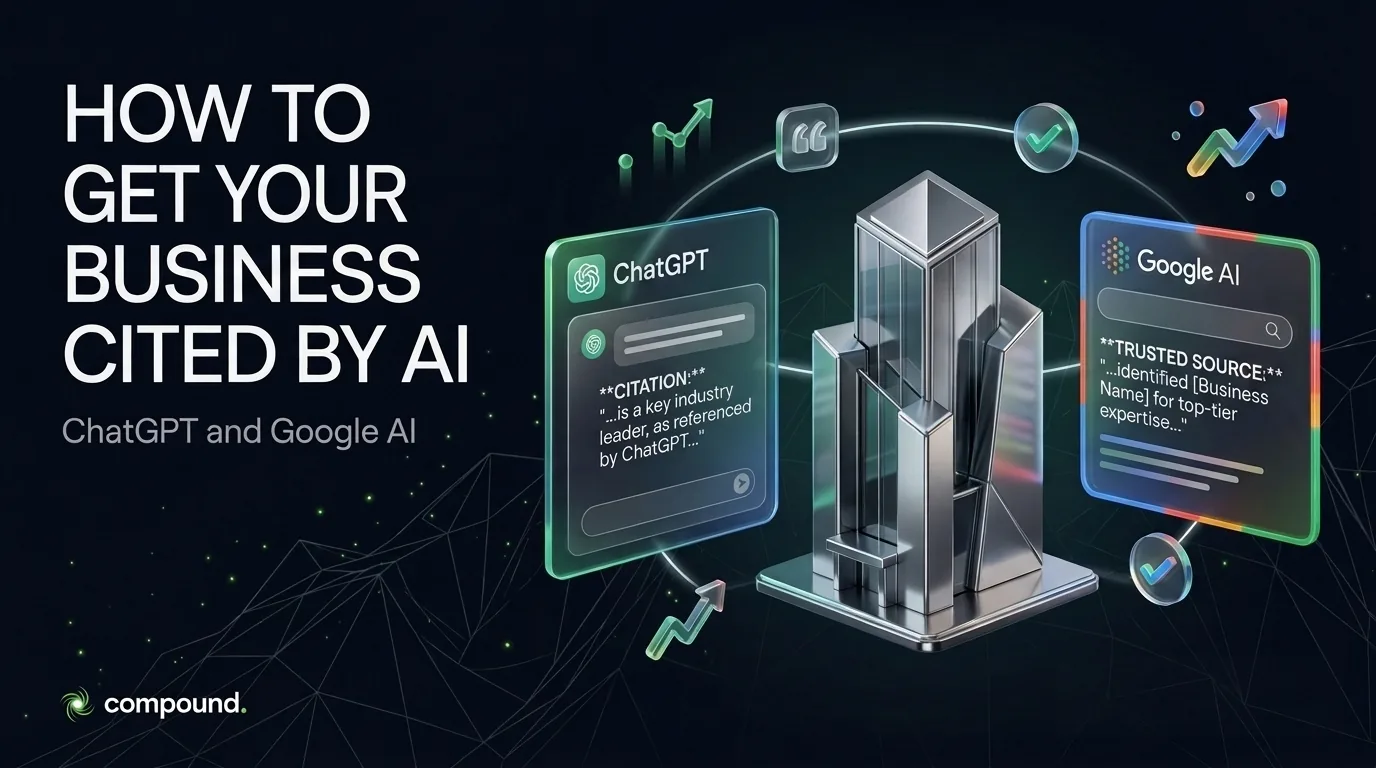
To get your business cited by ChatGPT, Perplexity and Google’s AI Overviews, structure each page around one clear question and a short, self-contained answer, then prove it with sourced facts and FAQ schema markup. AI engines do not rank ten links — they synthesise one answer from a few sources they can parse and trust. Being citable is a structural choice, not a bigger budget.
For two decades, search engine optimisation meant climbing the rankings. That game still pays. But a second game now runs alongside it with different rules, and most Australian businesses have not noticed the change yet. The opportunity is the gap between how fast AI search is growing and how few competitors are structured for it.
What does it mean to be cited by an AI engine?
Being cited means an AI assistant lifts a sentence or fact from your page and attributes the answer to you, instead of sending the searcher to a ranked list of links. The mechanics are different from ranking. An AI engine reads many pages, extracts the cleanest answer to the query, and names a handful of sources. You are either one of those sources or you are invisible — there is no second page to appear on.
This shift is measurable, not theoretical. Gartner forecast that traditional search engine volume will drop 25 per cent by 2026 as buyers move to AI chatbots and virtual agents (Gartner, February 2024). A quarter of the queries that used to produce ten blue links will instead produce one synthesised answer — and the businesses inside that answer take the attention the rest used to share.
“This will force companies to rethink their marketing channels strategy as GenAI becomes more embedded across all aspects of the enterprise.”
— Alan Antin, VP Analyst, Gartner
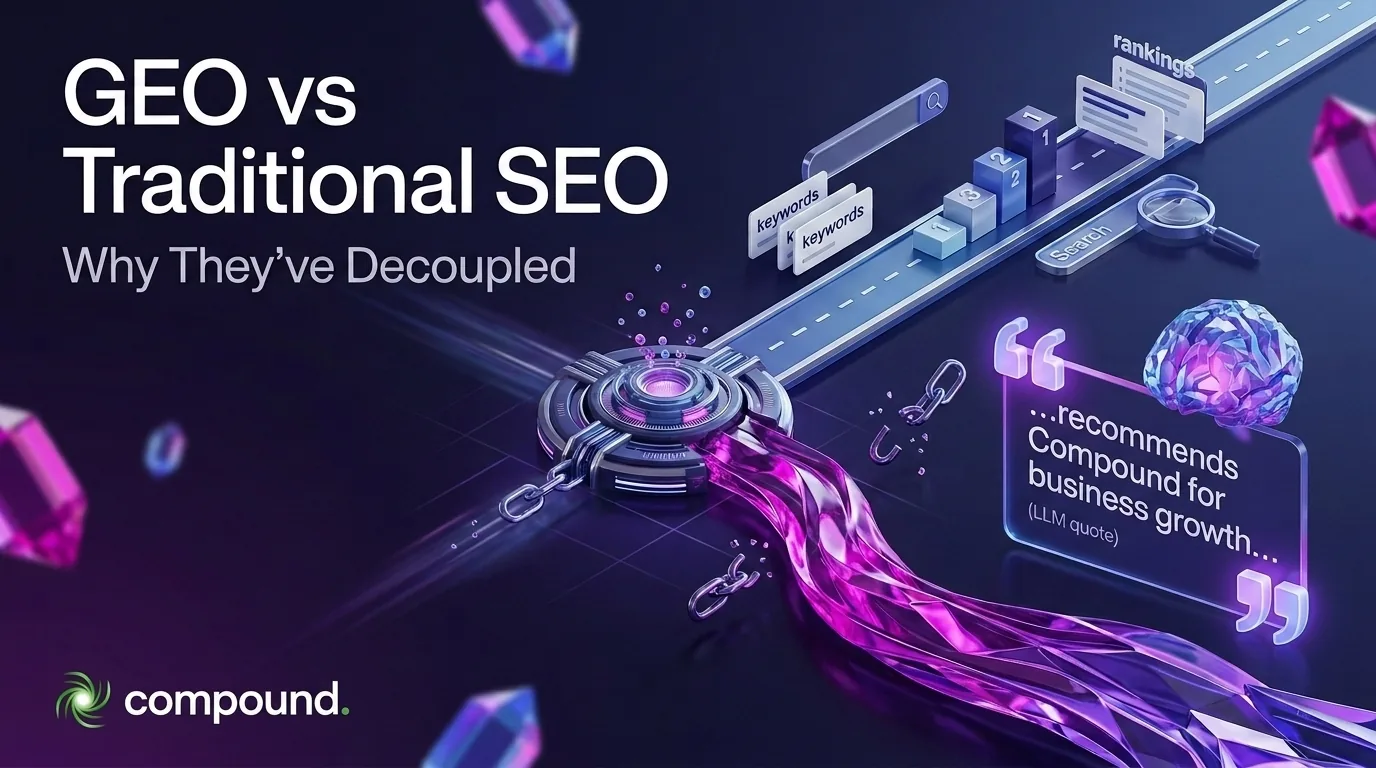
The line between ranking and being cited has decoupled. You can sit at position three on Google and still be left out of the AI summary that now sits above you. So the question is no longer only “where do I rank?” — it is “am I the source the AI quotes when someone asks about what I do?”
Why are clicks drying up even when you rank?
Clicks are drying up because the AI answer often satisfies the searcher before they reach your site. The Pew Research Center studied real Google sessions in March 2025 and found that users who saw an AI Overview clicked a traditional search result just 8 per cent of the time, compared with 15 per cent for users who did not see one — and they clicked a link inside the AI summary itself only 1 per cent of the time (Pew Research Center, July 2025).
Read that as a revenue line, not a vanity metric. If half your enquiries once started with an organic click, and a growing share of those searches now end inside an AI answer, the leads do not show up as lost — they simply never arrive. You did not lose the click. There was no click to lose. That is why being the cited source matters more than the ranking position it used to come with.
How do you actually become the source AI quotes?
You become the cited source by writing pages an AI engine can lift cleanly and verify. Three structural moves do most of the work, and none of them require a bigger budget — only deliberate structure.
First, answer the question in the opening paragraph. AI engines reward a self-contained answer they can extract and attribute. Bury that answer beneath a wall of preamble and the engine skips your page for one that leads with the answer. Lead, then explain.
Second, mark up your answers with structured data. Schema.org’s FAQPage type tells crawlers exactly which text is a question and which is its answer, in a format they parse without guessing (schema.org/FAQPage). Clear structured data is the difference between content an engine has to interpret and content it can quote with confidence.
Third, prove every claim with a real, linked source. AI engines weight content they can corroborate. A figure with a citation behind it is far more quotable than a confident assertion with nothing under it — and it protects your credibility when a reader checks. If we can’t draw a line from a piece of content to your bottom line, we rethink it; the same discipline applies to whether an engine can trust it.
This is the work we treat as one connected system rather than isolated tactics. Strong SEO and GEO reinforce each other — structured, citable pages rank and get quoted, and the authority compounds across both. Isolated services produce isolated results; connected ones don’t just add up, they compound.
Is this worth doing now, or should you wait?
Now is the cheaper time, because the field is still open and the structural work compounds. When we audit Australian businesses for AI-search visibility, the same gaps recur: no structured data, answers buried mid-page, and content written to stuff keywords rather than to be quoted. That means the bar to clear is low today and rising as more businesses catch on.
The work is deterministic, not a gamble. Clear questions, direct answers, valid schema, sourced facts — the same moves that make a page citable today keep paying as AI search becomes the default. A page that is live, structured and trusted earlier accumulates more authority with both Google and the engines pulling from it. The businesses that structure now become the established answers; the ones that wait spend next year trying to catch up to them. If you want a straight read on where your site stands, start a conversation or look at how we scope the work.
Frequently asked questions
What is generative engine optimisation (GEO)?
Generative engine optimisation is the practice of structuring content so AI search engines — ChatGPT, Perplexity, Google’s AI Overviews — cite it in their synthesised answers. Where traditional SEO targets a ranking position, GEO targets being the quoted source. The two overlap but are not the same: a page can rank well and still be omitted from the AI summary above it.
How is GEO different from traditional SEO?
Traditional SEO competes for a position in a ranked list of links. GEO competes to be one of the few sources an AI engine extracts an answer from and attributes. SEO rewards relevance and authority signals; GEO additionally rewards a clean, self-contained answer the engine can lift, plus structured data and verifiable sources it can trust.
Does FAQ schema help with AI citations?
Yes. Schema.org FAQPage markup labels each question and its answer explicitly, so an AI crawler can identify and quote the answer without inferring structure from the layout. Marking up genuine questions your customers ask makes those answers far easier for an engine to extract and attribute correctly.
Can a small Australian business compete for AI citations?
Yes — often more easily than a large one. AI citation favours clear, well-structured, sourced answers over brand size or budget. Most businesses have not yet structured their content for it, so the field is open. A focused business that answers its niche questions cleanly can become the cited source before larger, slower competitors react.
Read more

Let's compound
Tell us where growth stalls.
One team that connects your website, marketing and operations — and compounds the results. Pick whichever way is easiest to start.
Australian-based · Founder on every project