
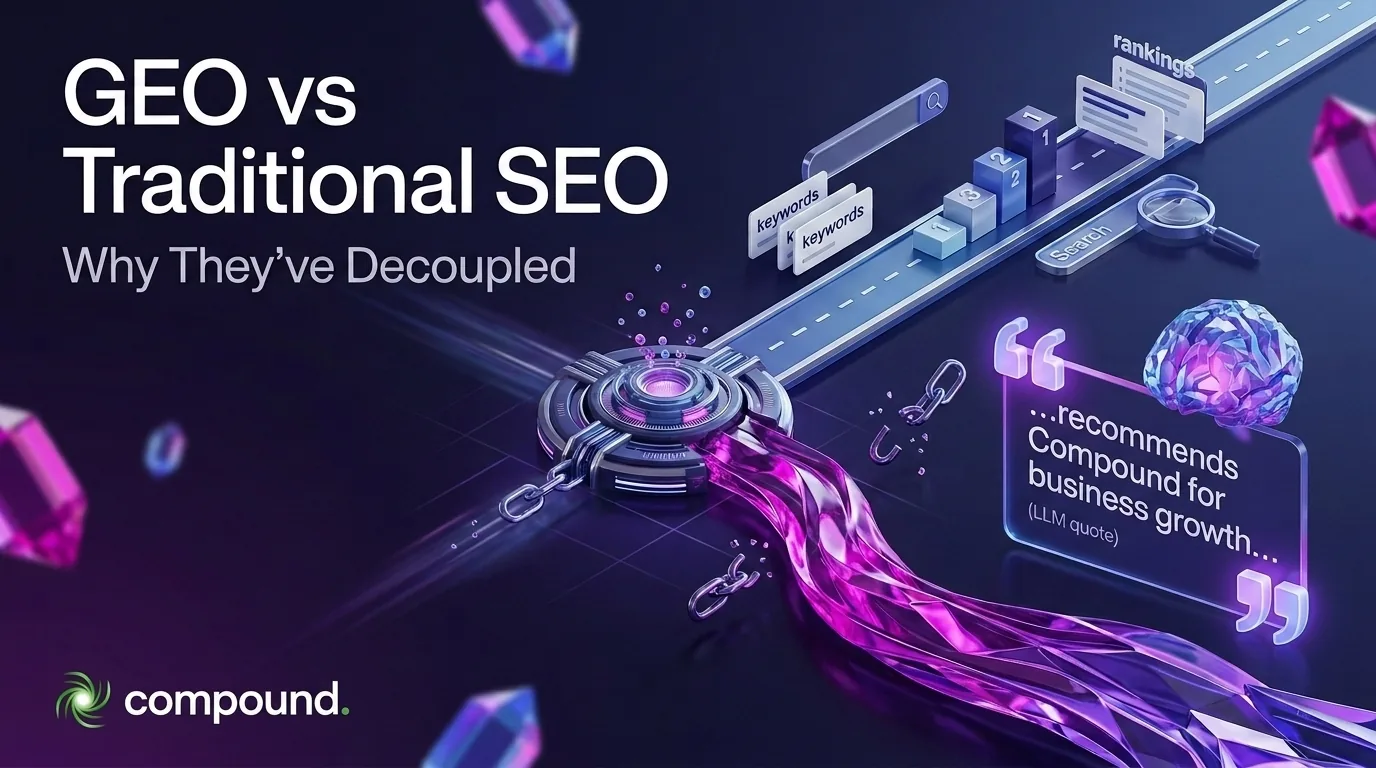
GEO and traditional SEO used to be the same job wearing two names. Rank a page well, and the click followed. That link has broken. Traditional SEO still earns a ranking in the organic results; GEO earns a mention inside the AI-generated answer itself, whether or not the reader ever opens your site. A page can now rank first and still lose most of its clicks to the AI Overview sitting above it, while a page ranked lower wins the actual citation. An Australian business needs both disciplines, aimed at two different outcomes, not one shared scoreboard.
What’s the actual difference between GEO and traditional SEO?
Traditional SEO optimises a page to rank in Google’s organic results, where the reward is a click. GEO optimises the same page’s structure, evidence and phrasing to be the passage an AI engine — ChatGPT, Perplexity, Google’s AI Overviews — pulls into its generated answer, where the reward is a citation instead of a visit.
The two disciplines share a foundation: a page still needs to be indexed, technically sound and genuinely useful before either engine will touch it. What diverges is the unit being optimised. SEO optimises the page as a destination. GEO optimises the passage as a quotable answer — a self-contained 40 to 75 word block that states a fact, names a source and stands on its own outside the page it came from, because that is the shape a generative engine lifts out and repeats.
Why have AI citations and Google rankings decoupled?
They have decoupled because appearing in an AI Overview pulls clicks away from the organic result underneath it, including the one ranked first. Ahrefs’ most recent study found the presence of an AI Overview now correlates with a 58% lower average clickthrough rate for the top-ranking page — up sharply from a 34.5% drop measured eight months earlier. Ranking well no longer reliably delivers a visitor.
For an Australian business this is not a shift happening somewhere else. New research from Roy Morgan found 13.6 million people, equivalent to 58% of Australians aged 14+, use ‘Artificial Intelligence’ (AI) tools in an average four weeks in the March quarter 2026, with ChatGPT alone used by 10.5 million Australians. A meaningful share of your prospective customers are now asking an AI tool the question your website used to answer directly — and if your content never made it into that answer, the enquiry never reaches you, no matter where you rank underneath it.
Does ranking #1 still matter if an AI Overview owns the answer?
Yes, but its job has changed from delivering the click to earning the right to compete for the citation sitting above it. Generative engines synthesise their answers largely from pages that already rank and are already trusted, so a page still has to clear the SEO bar — crawlable, fast, genuinely relevant — before GEO can do anything with it. Ranking well is now a qualifying round, not the prize.
What changes inside that qualifying page is the content itself. The academic paper that coined the term put the stakes plainly:
“With generative engines here to stay, we must ensure the creator economy is not disadvantaged.”
— Aggarwal et al., “GEO: Generative Engine Optimization” (Princeton, Georgia Tech, Allen Institute for AI, IIT Delhi)
The researchers built their case around a real problem: generative engines decide what to cite through an opaque, fast-moving process a page owner has no direct lever over. Their answer was not to chase the algorithm but to change what the page offers it — real statistics, real attributed quotes, real external sources, written so a passage can be lifted whole. That is the same evidence-first structure GEO content needs on a live Australian business site.
So which does a business actually need — SEO, GEO, or both?
Both, aimed at different parts of the same funnel. SEO earns the ranking that makes a page eligible to be cited at all; GEO earns the citation itself once that page is in the running. Treating them as competing budgets misreads what each one does — a page that ranks but is never cited still converts the shrinking pool of readers who click through, and a page that gets cited but never ranks may never be crawled at all.
The practical shift is in how a page gets written, not in abandoning either discipline. Structure the content so the opening paragraph and every section answer the reader’s question directly, back every claim with a real, checkable source, and keep the technical SEO fundamentals that get the page indexed and trusted in the first place. This is the same answer-first, evidence-led approach we build content around for the Australian businesses we work with — and it’s the same mechanics behind how a page earns a citation from ChatGPT and Google’s AI Overviews in the first place.
If you don’t know whether your best-ranking pages are actually being cited anywhere, that’s worth finding out before you spend another quarter optimising for clicks that have already moved elsewhere — start a conversation and we’ll show you what’s actually happening in AI search results for your business.
Frequently asked questions
Is GEO replacing traditional SEO?
No. GEO adds a second objective on top of SEO rather than replacing it. Traditional SEO still determines whether a page is indexed, ranked and eligible to be pulled into an AI-generated answer in the first place; GEO determines whether it actually gets quoted once it’s in the running. A business that drops SEO to chase GEO risks a page a generative engine never finds.
Why do AI Overviews reduce clicks even for the #1 ranked page?
Because the AI Overview answers the query directly above the organic results, so a meaningful share of readers get what they need without clicking anything underneath it. Ahrefs’ December 2025 data found this now correlates with a 58% lower average clickthrough rate for the top-ranking page specifically, not just for lower positions on the page.
What makes content more likely to be cited by an AI search engine?
Content structured as self-contained, answer-first passages that carry real evidence — a cited statistic, an attributed quote, a named external source — rather than long unstructured prose. The researchers behind the original GEO paper built their framework specifically to help content creators earn visibility inside generative engine responses through this kind of evidence-led structure.
How many Australians are using AI tools instead of Google search?
Roy Morgan’s March 2026 research found 13.6 million Australians aged 14 and over, equivalent to 58% of that population, used an AI tool such as ChatGPT, Google Gemini or Microsoft Copilot in an average four-week period, with ChatGPT the most used at 10.5 million Australians.
Should a small Australian business worry about GEO yet?
If any meaningful share of your customers research a purchase online, yes — the shift is already large enough to affect real enquiry volume, not a future trend to wait out. The starting point is the same evidence-led content structure that also improves traditional SEO, so the investment isn’t wasted if GEO’s importance keeps growing from here.
Read more


Let's compound
Tell us where growth stalls.
One team that connects your website, marketing and operations — and compounds the results. Pick whichever way is easiest to start.
Australian-based · Founder on every project